
Acronyms to save the world & think differently.

Cool HIVE is an acronym for Helping to Integrate Vibrant Ecology to Cool the planet.
MORE Accounting is an acronym to facilitate including Money Organisms Resources and Ecology on a bio-diverse bottom line.  Reducing our carbon emissions achieves both.  A Cool planet is more fun and more climate stable.  At MORE Carbon Savings, we are all part of the solution. Like bees each of us contributes a bit of pollen to the flower of positive change.

$20,000 raised for Dotors Without Boarders in our October 48 hour blogathon makes a world of difference.

A hungry child can wait in a food line for several hours to receive one scoop of gruel that is less than 500 calories.  We have raised $20,000 so far.  See Daily Klos article. Please donate today to feed a child  to  Oxfam or  Doctors Without Boarders.

The Drought in East Africa Continues.
"Despite knowing their environment well, people in the Turkana or Oromo regions of southern Ethiopia were unable either to predict or cope with the severity of the long drought. In Kenya, drought used to come every five years, and this region has always been food-insecure. Now drought seems endemic, and the local pastoralists' coping mechanisms are overwhelmed", writes Simon Roughneed on May 14, 2010.  This devastating drought continues today and increases with catastrophic proportions for all species. The depth and severity of the droughts in the Horn of Africa are the outcomes of climate change today. As more carbon is released into the atmosphere globally snow covered mountains melt, rivers dry and rain ceases to fall. All of our lives depend on making annual steps towards an a 80% reduction in carbon emissions.  A 5% reduction a year throughout, in efficiency, use, as well as increases in clean energy can make a world of difference. If we all take a step by step incremental approach throughout all aspects of the energy landscape we can achieve the goal and protect crucial habitat, thus reducing drought and famines in the long-term.  I hope my photographs inspire some of you to help in restoring balance to the lives of at least a few of these needy children. Please donate to feed a child today Oxfam or Doctors with  Out Boarders
Coming to the end of the food line the healthier kids have to wait until the very end to eat.
The problem is clear, lets discuss solutions. The destruction of crucial habitat due to climate change and the resulting droughts have led to serious threats of famine for over 12 million people. That is equivalent to fifty 2004 Tsunamis. Dry rivers and crop failure are now common place in East Africa and threaten both animal and human populations. This problem is not due to over population rather it is a systemic problem that is often a result of too little help too late and never addressing the fundamental foundational cause. The roots of the problem run very deep into the system of aid that began during the colonial era. If we instead combined food aid with local restorative sustainable development we may have a better long-term result. Much of this development can be paid for with clean development mechanisms that offset carbon in developed countries by purchasing clean development in developing countries. Population regulates itself in a well educated society that has the opportunity to live with dignity. More trees and more woman’s education result in less violence, fewer and healthier children who statistically build safer more balanced communities. Each reading education reduces population growth, infant death by a factor of 3 per capita. 


A cup of food (corn or beans) will be the only meal of the day. Some of that cup full is often brought home to share with other family and elders.
We can save a life with food, we can save millions with carefully designed systemic sustainable development. 

Three ways to save lives and the environment What kind of aid do you think has a positive effect throughout the system? Lets look at three things that make a world of difference to both the environment and the populations of animals and people living in that environment. Many solutions help reduce carbon emissions and poverty while  increasing education and habitat. This type of aide begins to heal and change the system and create positive feedback loops that grow in good ways exponentially. 
A wood fired pot that feeds 350 children in a Nairobi orphanage. I hear the coughing of the children who breath this smoke while taking this picture.
Solar Stoves Solar stoves for example help reduce carbon emissions and poverty. Girls are not pulled from schools to go look for wood on dangerous roads, crucial habitat that also protects micro climates are not cut down. Children no longer are breathing wood smoke from cooking fires. Carbon emissions in the area are reduced by 75% while  increasing education and habitat. Girls are now getting an education which in turn lowers birth rate, and infant death. Women who read teach their children to read. Education fosters sustainable development and healthier communities. That community might begin to manufacture ceramic water filters to share with other communities or begin to grow shade grown coffee which brings income and crucial habitat to birds. Within a short time the crime rate comes down as things return to natural environmental balance.  A positive feedback loop has been created that provides positive effects for many years and reduces health risks and the need for food-aid overall.

LED Lighting and small solar Panels Education and life of dignity regulate population growth. Women with a reading education have on average 2.5 children. We can teach girls to read with targeted carbon reduction methods that also protect the environment. LED lighting and portable solar panels reduce the use of wood fires and provides light in the evening for children to read by and for women to make crafts to sell at market after the sun goes down. They can burn less wood fuel, which keeps girls off dangerous roads look for fuel and water. They then have more time to learn development skills that can increase their incomes.

A well added in the Maasai Mara five years ago has kept thousands of people alive. 

Clean Water Wells and Portable filtration systems. Even low tech ceramic water filters can provide clean water and cottage industries. There are many water projects in east Africa more than ever we need significant investment and technological achievement to address this problem en – mass. A well that was installed in the area where I have worked extensively has kept 2500 people alive with clean water. It was placed near a school so that girls could carry it home after their lessons. Mothers come to help cook school lunch and carry water back to the village. This successful project has made a world of long-term difference with an investment of under $20,000.

Clean Development Mechanisms (CDM’S) Clean Development mechanisms are development projects that are funded by those who have not achieved the technological ability to reduce emissions at home and so fund carbon reductions in other parts of the world. CDM’s reduce carbon emission and poverty at the same time. They often increase community, education percentages and habitat by their positive systemic effects. In the long term the trillions of dollars of carbon in the atmosphere could fund projects that would end hunger in our lifetime.

Food Aid is an important Band-Aid but not a solution. Food aid may be an important Band-Aid for crisis situations but there will be no end to the growing need for Band-Aids if we do not address the roots of the problem and make positive systemic changes. Development projects that are designed with the whole system in mind may be a more helpful use of much of the funding and reduce aid costs overall within five years. Aid that looks for the connections and effects throughout the system can be carefully designed to solve these systemic problems and create positive feedback loops that often provide economic development while protecting the environment and increasing dignity for those most effected by the threats of climate change.

When we look into the eyes of our brothers we know we are fundamentally looking at ourselves and we must respond.

Your Personal Sustainability Goal. Lastly I believe each of us should make a personal sustainability goal and look into ways that we can individually reduce our emissions and design our lives to be of service to the world around us. We should try to restore systems as we give thanks for the resources they have provided. Please try to reduce your carbon emissions today and inspire those around you and in decision making positions to do the same. Each of us should leave a smaller footprint and we may find that in the end living with intention brings balance to our own psychic poverty’s. If we as individuals do not work toward a restorative economy that protects and builds a healthy environment we can not expect corporate entities and governments to. Desmond Tutu once told me, live by example, you wont believe the world of difference that can make. 

Children, Drought and Fuel

The children of East Africa are shouldering the burden of drought and climate change. 
A school well saves and protects lives of students in rural East Africa, but they are few and far between. 
A drought stricken waste land is no place for a child alone. This was lush grassland only a few years ago. 
Food Aid can provide relief but it is not a long term solution for the nutritional needs of children. 
Coal provides fuel but destroys habitats.  Solar stoves would make a wold of difference. 

Women walk miles to look for wood and water often on dangerous roads.

Maasai traditionally do not cut living wood but the drought has left them little choice if they are to survive. 

All children deserve an opportunity to thrive with dignity.  Reducing our emissions here can support  lives around the world. Cherish all our resources, use less and live more. Conserving resources protects the future of all living organisms. Living with dignity ourselves provides dignity for others. 

Root For Peace

Join  Daisy Carlson in the Root for Peace initiative. Accessible edible gardens and California native plants, that restore habitat here now also plant the roots of change globally as proceeds are donated to sustainable development in East Africa. Click here to find out more  

The dry lake in Amboseli, Kenya

After driving an hour in this dry lake the only water I found were tears.

Mount Kilamanjaro has lost most of its permanent snowpack.

Dust Devils picking up the smell of death across the Amboseli plain is not the abundant Safari land we once knew.

A Girl With 37 Parts Too Many

Lilian Pesi and her friends need our help.This PSA was shot in Kenya during the recent drought

Together we can build a sustainable future for girls like Lilian Pesi. Clean stove projects at schools and orphanages are a good start. They can be funded with carbon offsets. Once installed they have positive effects throughout the whole system. Clean stove projects keep girls in school rather than out on dangerous roads looking for wood and water. Clean stoves also reduce carbon emissions by 70% because they do not cut and burn wood fuel. Not cutting trees preserves habitat that continues to store carbon. Not burning wood reduces the amount of smoky air, the cause of serious health risks to children's developing lungs.  This integrated approach can provide targeted development that improves the entire system and provides solutions that are wide spread and long term. At the Irbaan school for example, we have installed a well so girls are not taken from school to look for water and it has also kept 500 people alive during Kenya's deep drought. Additionally they do not have to sterilize the water over wood fires so the trees are left standing.

As a designer of legacy products that have been providing sustainable cradle to cradle solutions since 1991 I've learned that problems ask for solutions, solutions often provide new business for local economies. Working together and taking the design challenge to end hunger in our lifetime while reducing emissions by 80% seems as much an opportunity as a problem. The  environmental movement is about MORE not less. 80% of a products footprint is established at the point of design. We not only need to design sustainable products we need to design sustainable systems that provide positive effects throughout the web of life. 
According to Carlson, "We are entering into a Restorative Economy, a re-design that will provide the lions share of future profits to those who find systemic solutions to the worlds environmental issues.  Products and profits will come from systemic solutions that redirect existing capital to clean energy solutions for a doubling population and eliminate deep poverty. We are creating a movement where we can all be part of the solution through transparent, seamless redirection of existing capital. Natures systems are abundant, productive and adaptive and so is our community. We can come together and redesign a system that works for everyone. A restorative economy builds wealth and environmental stability with a bio-diverse bottom line that includes MORE (Money, Organisms, Resources, and Ecology ) in every decision.  As you consider design and solutions  ask yourself what footprint you are leave. What seed are you planting.  Include MORE in your design and the system will improve overall and set a precedent for what is expected of designers. It has to improve the system not rob the system and have a holistic approach. This often increases product longevity. What does accounting for MORE mean? MORE puts Money, Organisms, Resources, and Ecology on the "biodiverse "bottom line and provides MORE value throughout the system that includes solutions for those in need.

I had wanted Cool HIVE to be a global HIVE where we could all work on systemic design and trade in solutions ideas and farm stuff. I wanted us to be able to Cool your credit card by having purchases offset by affinity programs. Connect, build and advise projects in the HIVE. Our slogan was "Come Buzz around with us and team up with friends to produce long-term legacy solutions that save lives with everyday activity." I was not big enough to do this. Nor do I have the personality to make something big like that, but it doesn't mean its not a good idea to team up with friends and brain storm on solutions that can protect our habitat and reduce carbon emissions and famine. Acting as a team. I live on a mountain and deer and native plants our my team. Partially I chose this after being in East Africa  and spending time with the Maasai, who are literally outside all day. They have a calm, regal quality and I knew that rushing around trying to save the day was not exactly the right solution.  If we could find a way The corporate challenge of paying the environmental date as they go while staying competitive me mean a redesign of a productive business system. Our lives need to connecting  to life giving systems that integrates with your daily life. Millions of girls like Lilian Pesi will thank you for Making the Planet Cooler  by reducing your carbon emissions by 5% and offsetting with a solar stove purchase.

We Have the Technology Now We Need the Will.


This was the little piece on CNN and in Times Square on Climate Action day Oct. 24, hosted by Bill McKibben and 350.
The Maasai Climate Action was challenging as on the day of the shoot elephants blocked the children's passage through the dry river so we didn't have a total of 350 kids at any one time. I would say, having seen the devastation of drought, East Africa shows Climate in Action. They endure unthinkable suffering from lack of water. That alone sends a clear message to the world. We need reality based climate policy TODAY. Each of us should make a personal sustainability goal to help reduce our emissions everyday. It matters to children all over the world today and tomorrow.

Solar Stoves Buy One Give One

Reduce CO2 emissions at home and while camping $25

Kibera Outskirts- Displaced People Crowd City Slum


What is The Cool HIVE?

What is Cool HIVE? The name alone tells the story, we are Helping to Integrate Vibrant Ecology (HIVE) to Cool the planet. We Cool the planet by lowering our carbon emissions. A Cool planet is carbon balanced and looks at systemic solutions that create a cascade of  positive responses.

What we want to build to achieve this?
Cool Sustainable Development - A robust revenue stream that funds carbon reducing sustainable development projects with existing business structures. The Cool HIVE revenue stream supports communities in need, while simultaneously reducing global carbon emissions and protecting the environment. Our current primary focus is on purchasing solar stoves for schools in East Africa.
Cool HIVE Forum - Share your ideas and business solutions in the The Cool HIVE  Honeycomb, a sustainable interconnected online architecture. Systemic connections are where solutions are found. Everyone can join in the upcoming Cool HIVE  architecture. With your honeycomb link we can pollinate ideas together and world class solutions will blossom.
Cool HIVE ShopHelp us get started by doing your online shopping in The Cool HIVE  Affinity mall with over 300 name brands. It is a simple way of carbon balancing your everyday purchases. The affinity mall will donate 2 - 15% of the purchase to The Cool HIVE and we will buy solar stoves with the money. This is one way to balance your carbon footprint. Carbon reductions help everyone you, future generations and all species in the environment.
Cool HIVE Credit CardSoon you can sign up for The Cool HIVE credit card and your everyday purchases will be carbon balanced.
Cool HIVE  has also created BeDelightful a Fair trade market place model, here hand-made product offerings help lift people out of poverty with their beautiful natural crafts. The profits are donated to  sustainable development projects that reduce poverty and carbon emissions simultaneously.
Cool HIVE is just getting started. If you would like to help make the planet cooler and build The Cool HIVE please contact Daisy Carlson for an executive summary and business plan at daisy@CoolHIVE.com. Millions of girls like Lilian Pesi, will thank you.
How coal contributes to Kenya's deforestation

The externalities of the fossil fuel business, like the US coal industry, include drought due to climate change. Here in Kenya, as crop yields are diminished due to lack of water, impoverished populations cut even more equatorial forests to increase crop lands. As water becomes dirtier more wood is turned into charcoal and burned to purify it. Fresh food is extremely limited resulting in longer cooking time for hard soaked corn and dried porridge. Trying to meet their most basic needs a virtually carbon neutral population is rapidly become more carbon intensive in an attempt to stay alive. As the world turns its back, Kilimanjaro is loosing both snow and tree cover. Kenya is loosing species diversity at an alarming rate. Lakes and rivers fed by Mt Kilimanjaro's snow cover and micro-climates have all dried up. The Maasai have no place left to walk to find water. Children are thirsty, hungry and being abandoned across the country. A clean energy economy can end hunger in our lifetime and restore habitats that have been marginalized by climate change and our fossil fuel dependence. With just 387 parts per million carbon equivalent in the atmosphere we can see the devastating effects climate change is already having. Are we really willing to continue with our focus on a mono-crop of money while all other valuable assets diminish. We are borrowing heavily not only from our children's future but on our own. Stop climate change NOW, Use Less live MORE.

Irbaan School - Maasai Mara, Kenya


Irbaan Primary School, Maasai Mara, Kenya, opened with three classrooms in November 2007, thanks to the generosity of international donors. The school, serves communities spread out for over the vast grasslands of the Mara region in Kenya, is still in need of ongoing support to provide a quality education to the hundreds of children in the area. More classrooms are needed to accommodate all the children and school supplies from textbooks to desks are in short supply. Funding for enough teachers that includes salaries and accommodation $300 a month, will help keep classroom sizes of reasonable size. Children, who walk as far as 7 kilometers to school, each way, often on an empty stomach, need a hot lunch to be provided. Provide an individual scholarship, $300 a year, and we will include you on the donors page of the Charming The World, Maasai book. I am astounded at the number of children in this touristed region that still lacked access to basic essentials like fresh water and food. This is an opportunity for the first generation of Maasai girls to go to school, and their first opportunity to experience physical and intellectual autonomy. Their young fathers appreciate what education did for them and want to share this gift with all their children. This generation values education and can transform the brutality of poverty into potential.
This well put in about 18 months ago currently sustains 500 people. This area in the Mara has not seen rain for two years. I was there during that last rain. I remember the panic I felt seeing thousands of dead Wildebeest carcasses float into the water stream of hundreds of villages along the Mara river. Children go to school to get a meal. Usually corn and mush cooked over fires from the 50 lb. burlap WFP sacks. I go from school to school and find children lining up for a scoop of corn and see the little ones trying to carry some home for their siblings. It makes tears come to my eyes every time I see it. As the cows die from drought and the milk dries up these children will soon be facing the dire consequences of malnutrition that has come about from climate change today. Yes these are the consequences of climate change, our emissions here are killing children there. We are all complicit in this crime against humanity. Clean development mechanisms are an essential part of climate policy. They will provide sustainable development to those most affected by climate change......children like these.

Kibera Slum Kenya, just after the first rains.

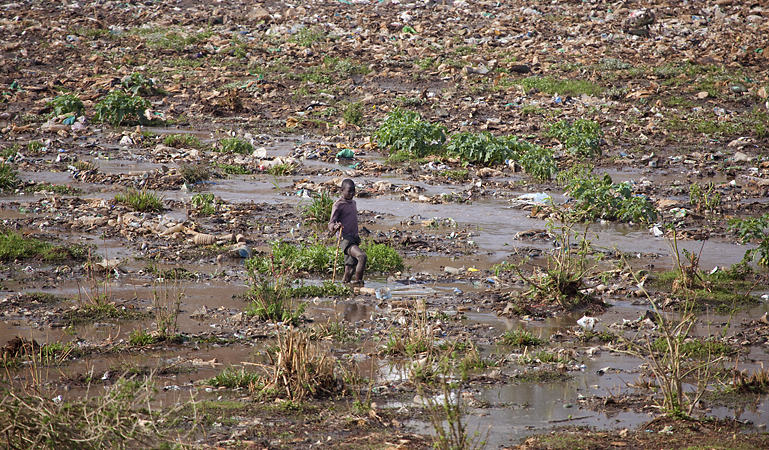
This garbage strewn swamp was once the Nairobi damn, a place where people water skied and fished. Children now wade through the sewage and muck to fight with pigs over scraps behind the overcrowded Kibera slum. Rollling black outs in Nairobi occur because the hydroelectric plant doesn't have enough water to power it


Carbon balanced shopping at no additional cost to you!  Over 300 brands will donate 2 to 15 % of the sale to help us buy solar stoves. These stoves not only reduce carbon emissions they save lives. Now you can easily balance your environmental footprint by helping to provide children, like Lilian Pesi, with sustainable development and clean energy. Our mission is to reduce carbon and poverty while increasing education and habitat at the same time. Purchasing Solar Stoves at schools and orphanages in East Africa help make this a reality.  Cool HIVE reduces emissions with these sustainable development projects that create positive effects throughout the entire system. For example, solar stoves protect habitat by keeping wood from being cut and burned. Fewer wood cooking stoves mean less dangerous soot in the lungs of these communities. Girls can stay in school instead of being sent out on dangerous roads to look for wood. By staying in school she can learn to read, which helps the whole system become healthier and more stable. Literacy exponentially improves childrens health, reduces population and insures that all future generations connected to her will also learn to read. This is what deep system sustainable development is all about.
Our Goals :

 Cool HIVE wants to help you connect with community to build and advise projects. Together we can balance our environmental debt with transparency and confidence. Come Buzz around with us and team up with friends to produce long-term legacy solutions that save lives. Cool HIVE pays the environmental debt as we go.  We are building a restorative economy within an existing affiliate revenue system.  This way you can participate at a level that makes sense for you.  Cool HIVE helps you connect with a restorative economy in a way that integrates with your daily life.

Join Daisy's Simulcast Sunday August 7, 8:00 AM to 10 AM in the 48 hour Blogathon to Aid East Africa. 
Over the course of the weekend, experts in the field of humanitarian assistance will join environmental writers to outline the history of the region and detail how geopolitics, colonialism, ongoing civil wars, climate change and geographic vulnerabilities have combined to create the perfect storm now ravaging East Africa. 
Please consider making a Donate directly to Oxfam in the horn of Africa. immediately to help in the immediate famine efforts. Organizations helping in these efforts 
Sunday 10:00 to 12:00 AM), 

Be DeLightful opens a fair trade gift shop.


Over the holiday's Be DeLightful opened a pop up store in Mill Valley, CA to 
Charm the World for the holidays. The shop helped over 400 artisans, offset 800,000 lbs. of carbon with CFL giveaway program and with the profits we are able to purchase about 100 solar stoves in East Africa. Our sales support sustainable development with investments that protect human health, the environment and education. You can Charm the World too at the Be DeLightful website where conscious giving is a breeze and creates a chain of positive effects  by selling a wide selection of fair trade high-quality goods from around the world while raising money for deep sustainable development.

Enjoy Beautiful gifts at a discount and save lives.

Daisy Arts donates 10% or their profits towards the purchase of clean stoves for schools in East Africa.

A Bright Idea from BeDelightful and CoolHIVE !


Save $60 with each Be DeLightful order and help the planet. We ship every order with a free CFL Lightbulb. This saves you over $50 on your electric bill and the bulb purchase, while also carbon balancing every order. Join us in making a world of difference with a Bright Idea.

CFLs are significantly more energy efficient than incandescent light bulbs because they require less energy to provide the same amount of light. An ENERGY STAR qualified CFL can save about $50 in electricity costs over its lifetime. The use of compact fluorescent light bulbs, rather than incandescent light bulbs, reduces the release of mercury and greenhouse gases from coal-burning power plants. If every home in America replaced just one incandescent light bulb with an ENERGY STAR qualified CFL, it would save enough energy to light more than 3 million homes and prevent greenhouse gas emissions equivalent to those of more than 800,000 cars annually. One Compact fluorescent light bulbs is one 5% step in your energy reduction at home and they are also more cost effective because they last up to 10 times longer than incandescent light bulbs. If everyone in the energy landscape took a 5% step in emissions reductions annually we could achieve significant emissions reductions to protect our environment and global health. Step by step we can have a very positive impact.It is important to remember to recycle at CFL drop boxes to reduce toxins in the trash and recycling stream. Enjoy knowing that you helped the planet with a Bright Idea from Be DeLightful.

The New Race

Who is fueling climate change.
Drought has claimed the lives of more than just cattle in the Maasai regions of Kenya.
Maasai children want to talk to you about the effects of climate change on their lives and yours.


 The Kibera slum is home to thousands who flea the barren landscape to look for work.
Young man looking for food in the junk and sewage of the Kibera slum.

One of the many dry river beds of Kenya., the great Mara River.
Without water and cattle their culture is under serious threat.

NEW Photo Project - What's the Beef in Marin?

Food should be LOADED with Goodness (Local, Organic, Affordable, Delicious, Elegant and Delightful ) I will be on lots of farms as I begin a new book on our local food producers and look for solutions for sustainable development in Agriculture of East Africa. For fun I am collecting recipes with 100 % local ingredients if  you would like to share. Many of these producers can be found at Whole foods and farmers markets and can be purchased with out plastic packaging.It is an honor to introduce you to the farmers and stewards of our food and land.


BEEF - I photographed Stemple Creek farm yesterday while participating in MALTS Bike Beef and Beer Event. A 50 mile ride followed by locally produced picnic lunch. We learned  about beef production and the Marin Agricultural Land Trust.  I committed to buy a 1/4 to 1/2 of a steer, about 110 lbs. to 220 lbs. of organic, grass fed, marin beef at about $5.40 lb. (retail $20).  I am looking for beef buddies. My neighbor is buying 20 lbs. You in? They are almost sold out for the last  harvest of the year so I need to give them the quantity by Wednesday.  I am lining up my buddies to "Have a Beef with".   http://www.stemplecreek.com/our.html  
consider becoming a member of Malt, Marin Agricultural Land Trust. Helping to preserve farmland, helps you get to know farmers through their unique events that support the preservation of organic small producers and their lands.

VEGETABLES - If you are interested in the biggest, and best box of in season organic veg. picked that morning for $25, follow me to the rogue market. County Line Harvest shows up at great resturaunts 1- 2x a week with mixed veg. boxes. Love for you to join me for a glass of local wine and apetizer after we grab our abundant boxes. Meet new friends, eat good food and take home a weeks worth of amazing fresh flavorful veg.    For Schedule see   http://www.countylineharvest.com/Rogue_Markets.html

FULL FAT - I was talking to a local professional nutritionist, Donna Shoemaker, who has the scoop on the importance of our land and location of our foods and what to eat to avoid disease in our body. Her first tip recommends eating full fat dairy to reduce sugar cravings. I am not interested in getting into an argument. I like the taste of whole milk yogurt so I eat it. Its the way nature made it and for me nature has always proven to be well designed. This is my personal choice after checking out other camps and noticing that the french aren't too fat I like my choice. I have nothing against the low fat camp. I find I can reduce calories for example by cutting thinner slices of full fat cheese, they are just as satisfying as thick ones and I haven't destroyed the flavor.
  I visited the Benoit Creamery that makes full fat yogurt on Thursday. The creamery is on John Matto's 500 acre ranch of jersey cows (which produce some of the richest milk around, thanks to a high percentage of proteins and butter fat). He sells the Benoit family the milk, they mix it with a culture they brought with them from France, and local farm-fresh fruit and honey, including Twin Girls Farm’s stone fruit and Marshall’s Farm’s honey. The Yogurt sets up in their signature ceramic pots and voila healthy,delicious,  full fat yogurt. http://www.stbenoit.com/